
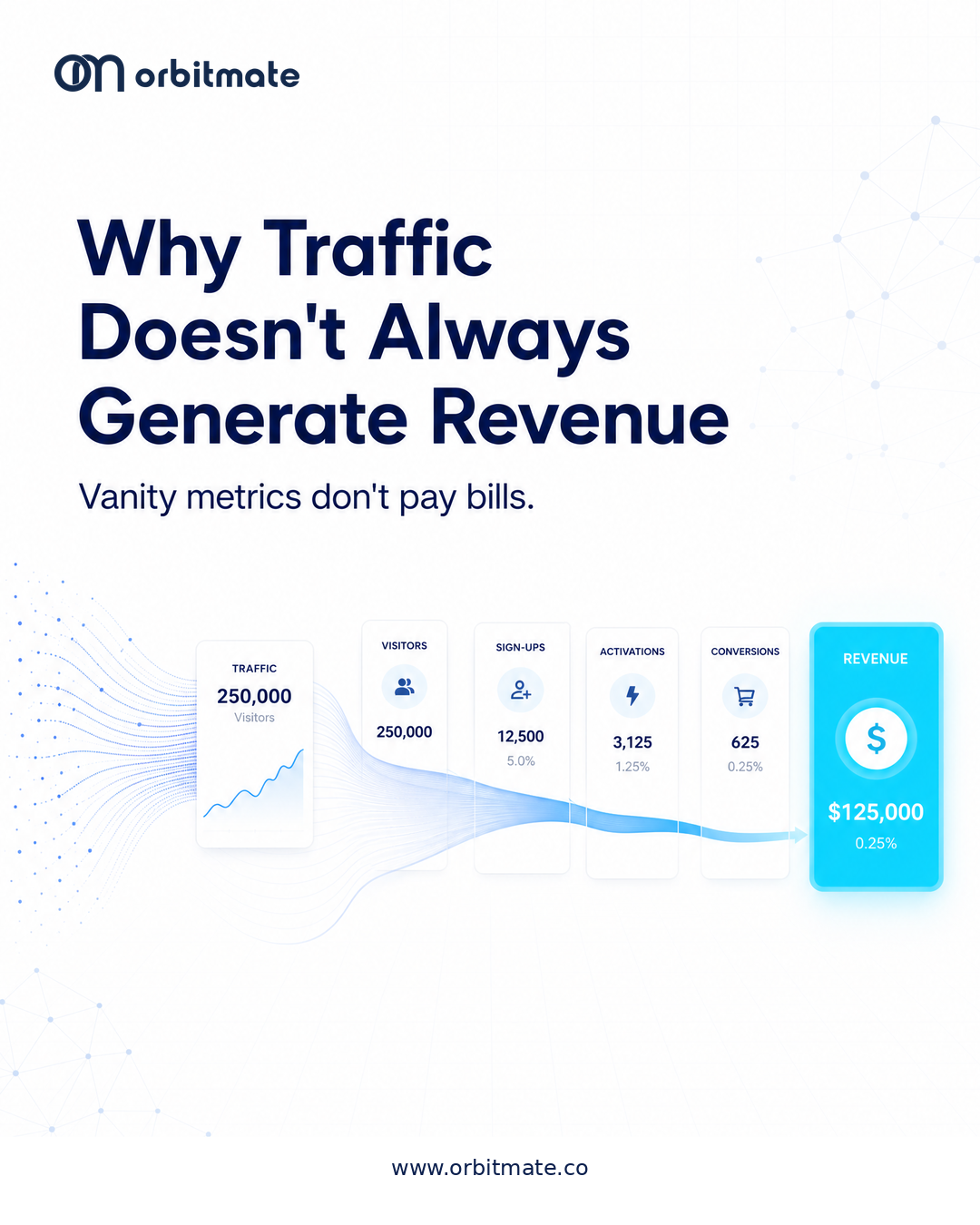
Many businesses mistakenly equate website traffic with business success. However, traffic doesn’t generate revenue on its own. A site can receive 100,000 monthly visitors, but if they bounce immediately or lack purchase intent, your bottom line remains unchanged. This happens when marketing strategies prioritize vanity metrics vs revenue metrics, ignoring the actual customer journey. To scale sustainably, you must shift focus from mere visibility to measurable business outcomes.
What Is the Real Customer Journey to Revenue?
Understanding the funnel is critical. Traffic is only the top of the funnel. The complete journey looks like this:
- Traffic: Visitors arrive via organic search, ads, or social media.
- Leads: Visitors provide contact info (e.g., downloading an eBook).
- Qualified Leads: Prospects matching your ideal customer profile (ICP).
- Customers: Leads who make a purchase or sign a contract.
- Revenue: The actual monetary value generated from customers.
Example: A B2B SaaS company might get 10,000 blog visitors (Traffic), but only 50 request a demo (Qualified Leads), and 5 close at $1,000/month (Revenue). Chasing traffic without optimizing the middle and bottom of the funnel is a leaky bucket.
Vanity Metrics vs. Revenue Metrics: What’s the Difference?
Vanity metrics look impressive on paper but fail to correlate with financial health. Revenue metrics directly impact your bottom line.
| Metric Type | Examples | Why It Matters (or Doesn’t) |
|---|---|---|
| Vanity Metrics | Pageviews, Social Likes, Total Followers | Inflates ego; does not indicate purchase intent or ROI. |
| Revenue Metrics | Conversion Rate, CAC, LTV, ROAS | Directly ties marketing efforts to profitability and growth. |
How Do Traffic Sources Impact Conversion Quality?
Not all traffic is created equal. A local bakery getting 500 visitors from "bakery near me" searches will outperform a viral TikTok video bringing 50,000 global viewers who cannot physically visit the store.
| Traffic Source | Typical Intent | Conversion Quality |
|---|---|---|
| Organic Search (SEO) | High (Informational/Commercial) | High: Users actively seek solutions. |
| Paid Search (PPC) | Very High (Transactional) | High: Captures immediate purchase intent. |
| Social Media (Organic) | Low to Medium (Discovery) | Medium: Requires strong retargeting to convert. |
| Display Ads | Low (Awareness) | Low: Best for top-of-funnel brand building. |
Which KPIs Should You Monitor for Real Growth?
To ensure conversion rate optimization efforts translate to profit, track these essential KPIs:
- Conversion Rate: Percentage of visitors completing a desired action.
- Cost per Lead (CPL): Total ad spend divided by new leads generated.
- Customer Acquisition Cost (CAC): Total cost to acquire a paying customer.
- Customer Lifetime Value (LTV): Total revenue expected from a single customer. (Rule of thumb: LTV should be 3x your CAC).
- Return on Ad Spend (ROAS): Revenue generated for every dollar spent on ads.
- Revenue per Visitor (RPV): Average revenue generated per unique site visitor.
- Qualified Leads: Leads that meet specific demographic and behavioral criteria
How Can You Turn Visitors Into Paying Customers?
To learn how to turn website visitors into customers, implement these actionable strategies:
- SEO & AEO (Answer Engine Optimization): Optimize content for Google AI Overviews and voice search by providing concise, direct answers to "People Also Ask" queries.
- Landing Page Optimization: Align ad copy with landing page messaging. Use clear, singular Calls-to-Action (CTAs) and remove navigation distractions.
- Content Strategy: Create bottom-of-funnel content (case studies, pricing pages, comparison guides) that addresses specific buyer objections.
- Trust Signals: Display customer testimonials, security badges, and recognized client logos to reduce purchase friction.
- CRO Testing: Run A/B tests on headlines, button colors, and form lengths to incrementally boost conversion rates.
Frequently Asked Questions (FAQs)
1. Why is high website traffic not increasing sales?
High traffic without sales usually indicates poor targeting, weak landing page messaging, or a lack of trust signals, resulting in high bounce rates.
2. What is the difference between vanity metrics and revenue metrics?
Vanity metrics (e.g., pageviews) measure superficial engagement, while revenue metrics (e.g., CAC, LTV) measure actual financial impact.
3. How do I optimize for AI search and AEO?
Structure content with clear H2/H3 headings, use bullet points, and provide concise, factual answers (40–60 words) to common industry questions.
4. What is a good LTV to CAC ratio?
A healthy LTV to CAC ratio is 3:1 or higher, meaning you earn three times more from a customer than it costs to acquire them.
5. How can I improve my conversion rate?
Improve conversion rates by aligning user intent with landing page content, speeding up page load times, and adding strong trust signals like reviews.
Key Takeaways
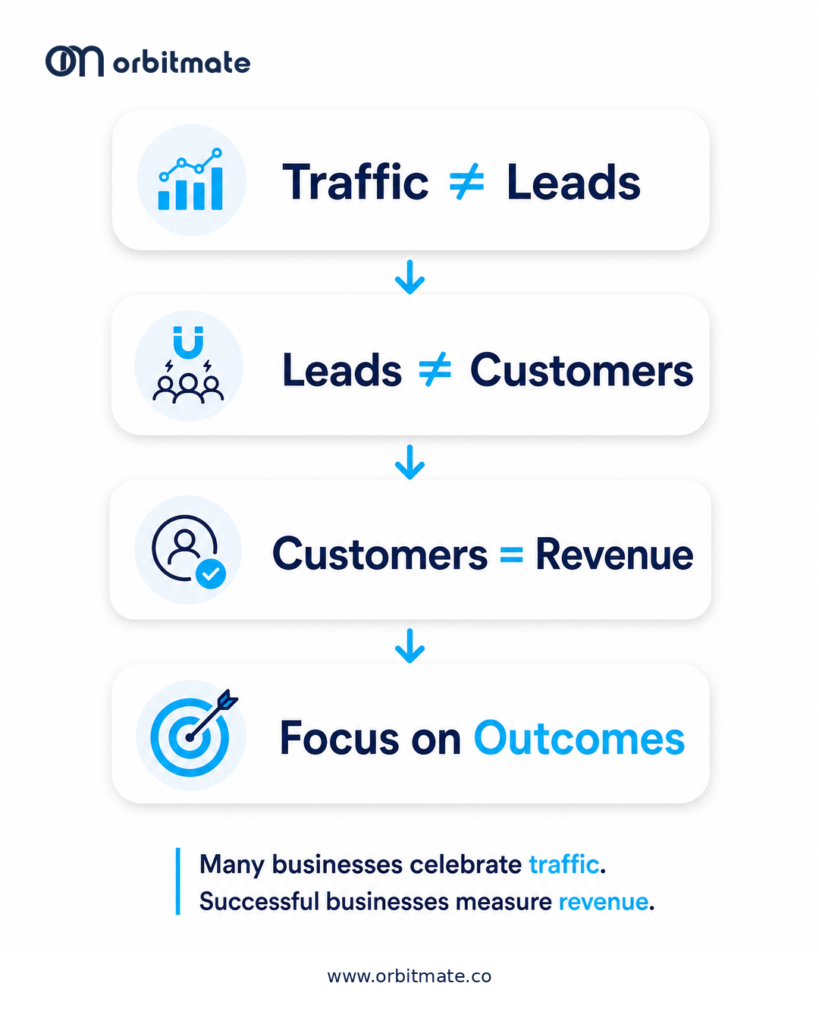
- Traffic ≠ Revenue: Visitors only matter if they convert.
- Track What Matters: Shift focus from pageviews to CAC, LTV, and ROAS.
- Optimize the Journey: Use SEO, AEO, and CRO to guide users from awareness to purchase.
Conclusion & Next Steps
Chasing traffic is a vanity game. Sustainable growth requires a relentless focus on revenue-focused metrics and a frictionless customer journey. Stop celebrating empty pageviews and start optimizing for outcomes.
Ready to transform your traffic into predictable revenue? Audit your funnel today, implement these CRO and AEO strategies, or contact our team for a data-driven growth assessment.