
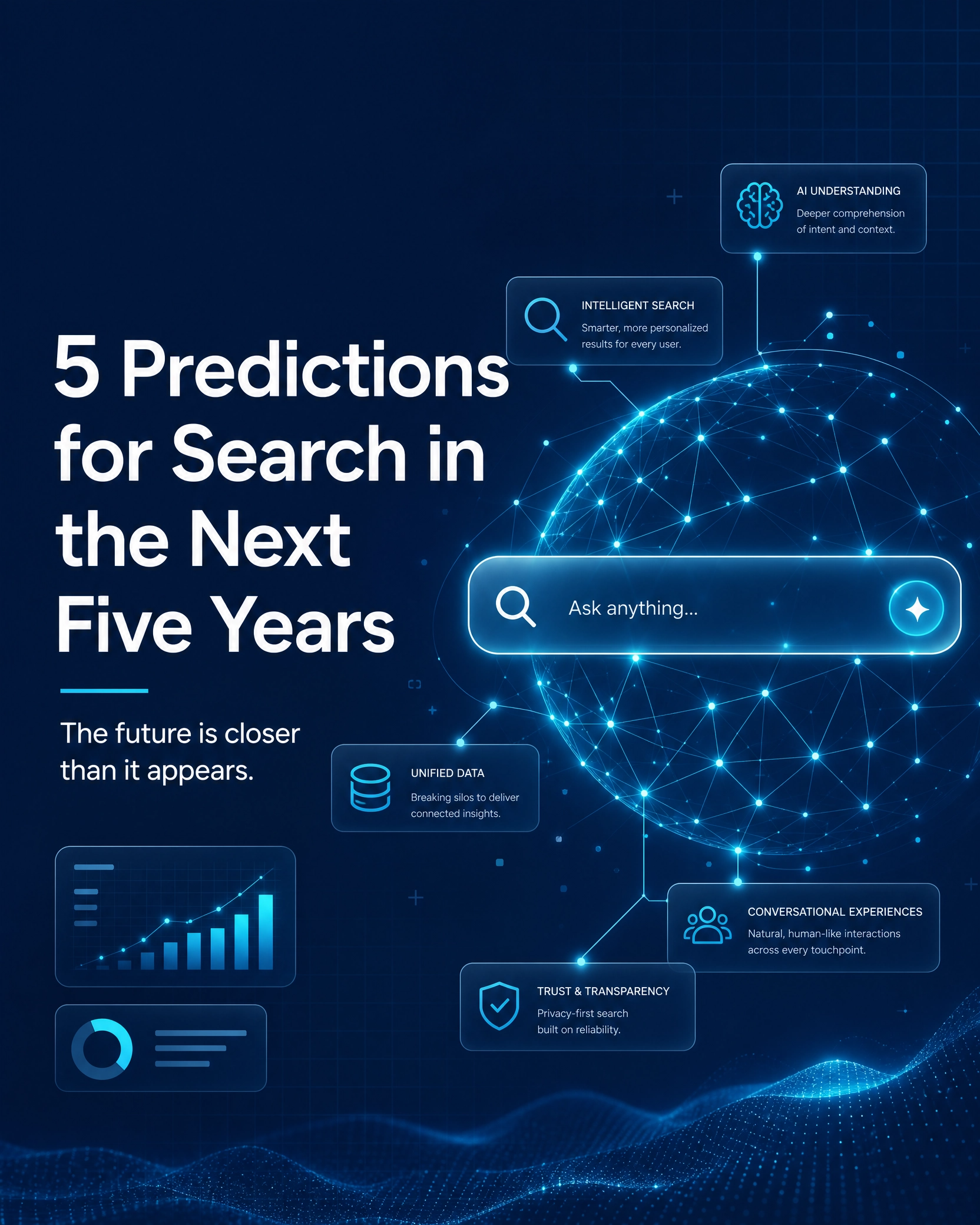
Search is experiencing its most dramatic transformation since Google's inception. AI Search Optimization is no longer optional—it's essential for survival. With Google AI Overviews appearing in 15-20% of searches and ChatGPT processing 200+ million weekly users, the future of search favors businesses that adapt now.
These five search predictions will define digital visibility through 2030. Understanding them isn't just strategic—it's critical for maintaining competitive advantage in an AI-dominated landscape.
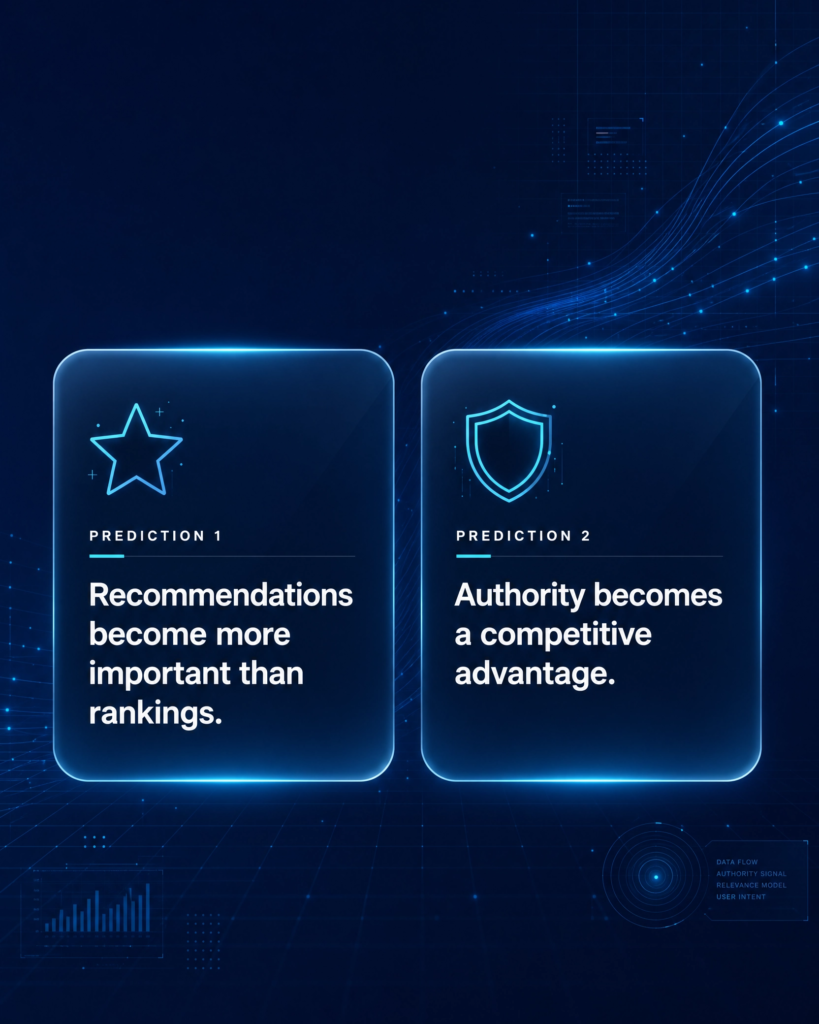
Why Are Recommendations Replacing Rankings?
Traditional SEO obsessed over position #1. That era is ending. AI-powered search engines now prioritize personalized recommendations over static rankings, analyzing user behavior, context, and intent to deliver tailored results.
Key insight: 60% of users prefer AI-generated answers over traditional blue links for complex queries. When someone searches "best CRM for small businesses," AI doesn't just list options—it recommends based on company size, industry, budget, and integration needs.
What this means: You're no longer competing for keywords; you're competing for relevance in specific contexts. A home improvement retailer might rank #3 for "cordless drill" but appear in 47% of AI recommendations for users who previously searched "DIY deck building."
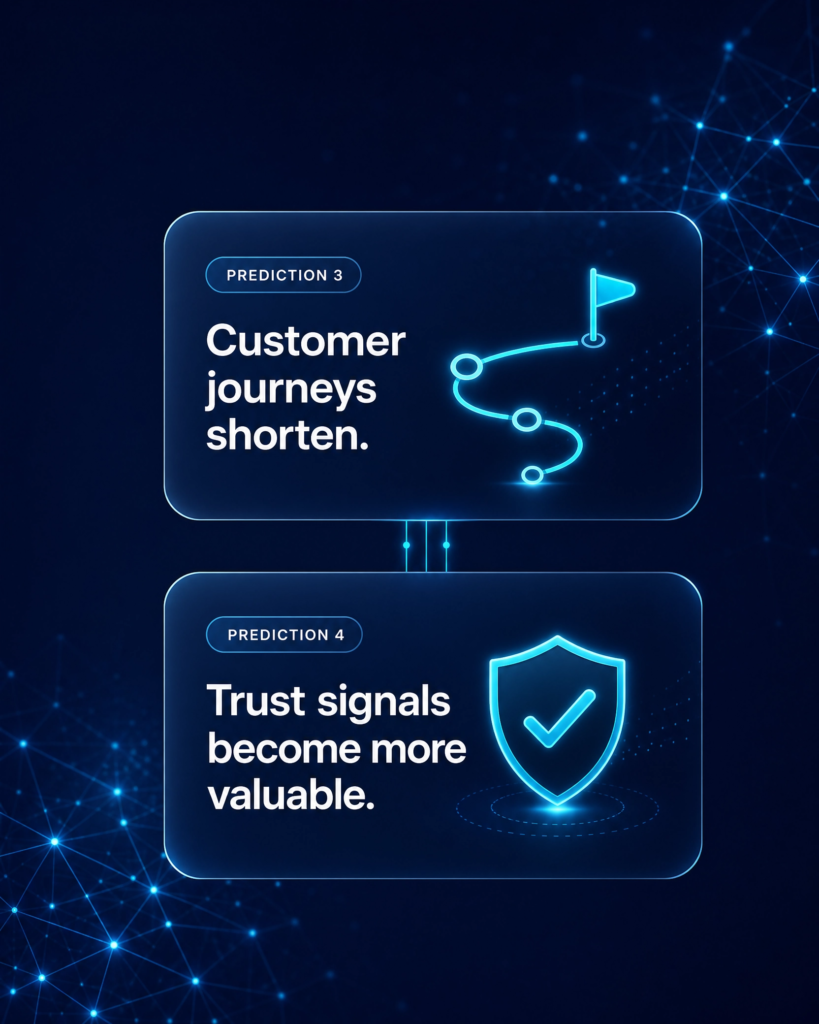
How Does Authority Become a Competitive Advantage?
Google's E-E-A-T framework (Experience, Expertise, Authoritativeness, Trustworthiness) has evolved from guideline to core ranking factor. In AI search, authority isn't just important—it's the primary differentiator.
The data: 78% of AI Overviews cite sources with high domain authority. Content from recognized experts receives 4.2x more AI recommendations. AI systems cross-reference claims against authoritative sources to mitigate hallucinations and misinformation.
Real-world example: When users search medical information, Mayo Clinic and NIH appear in 89% of AI-generated answers. Personal blogs? Less than 3%. AI prioritizes verified credentials, institutional backing, and established expertise.
Action step: Publish original research, secure executive bylines in major publications, and implement Person schema markup with verified credentials.
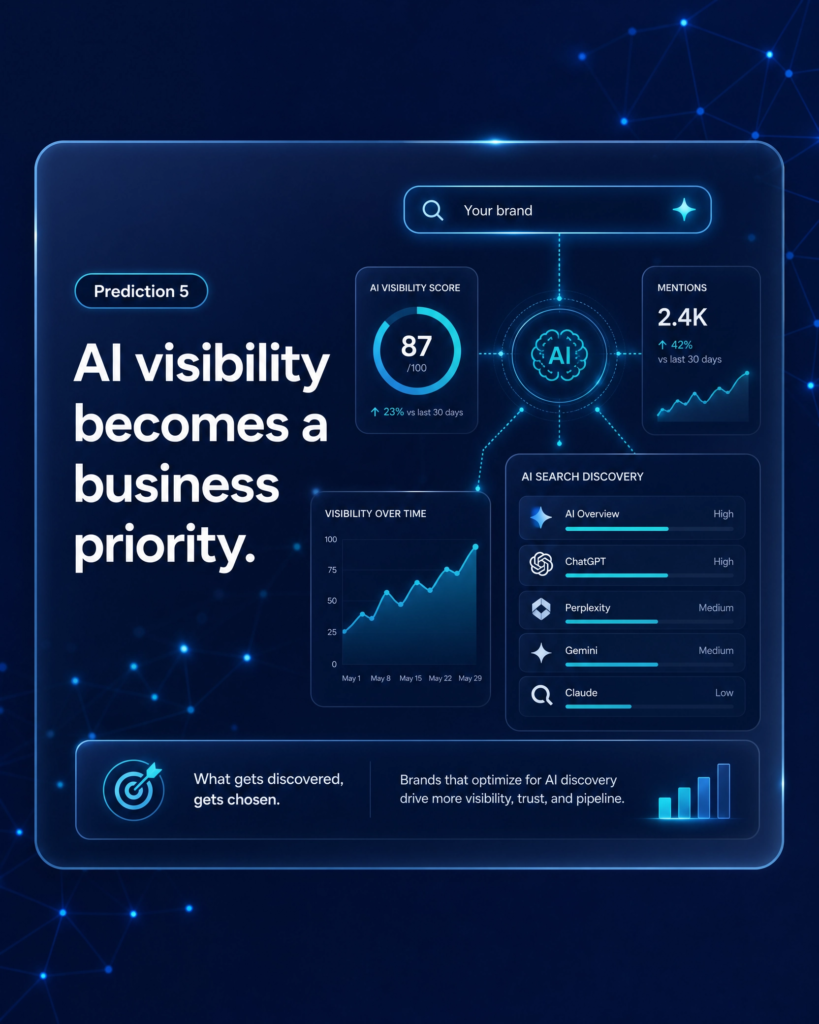
Why Are Customer Journeys Getting Shorter?
AI is collapsing traditional marketing funnels. The linear progression—awareness → consideration → decision—is compressing into single-session conversions.
Statistics that matter:
- 43% of AI search users complete purchases within the same session
- Zero-click searches represent 50%+ of mobile queries
- AI Overviews reduce average time-to-answer from 3.2 minutes to 47 seconds
The transformation: A travel search that once took 4-7 days and 25+ touchpoints now completes in 15-30 minutes with 3-5 interactions. AI provides instant comparisons, synthesizes reviews, and enables in-chat booking.
Implication: You must win the moment, not just the ranking. Optimize for micro-moments with instant load times, decision-ready content, and frictionless transactions.
What Makes Trust Signals More Valuable?
As AI-generated content floods the internet, trust signals are emerging as the ultimate currency. Users and AI systems are hyper-vigilant about source credibility.
Critical trust signals include:
- Technical: HTTPS, Core Web Vitals, mobile-friendliness
- Content: Author credentials, citations, publication dates, correction policies
- Brand: Verified reviews, industry certifications, media mentions, transparent contact information
Case study: A regional hospital network implemented physician credential transparency, medical review boards, and verified patient reviews. Result? AI recommendation rate jumped from 12% to 58% in 12 months.
Bottom line: Sites lacking clear trust signals are filtered from AI recommendations regardless of keyword optimization.
How Can Businesses Prepare for AI Search?
AI visibility is transitioning from experimental to essential. Organizations treating AI Search Optimization as strategic priority will dominate; others will become invisible.
Traditional SEO vs. AI Search Optimization
| Factor | Traditional SEO | AI Search Optimization |
|---|---|---|
| Goal | Rank #1 for keywords | Appear in AI recommendations |
| Content | Long-form articles | Conversational Q&A + structured data |
| Measurement | Rankings, traffic | AI visibility score, citation rate |
| Timeline | 6-12 months | 3-6 months initial visibility |
90-Day AI Search Optimization Checklist
| Priority | Action Item | Timeline |
|---|---|---|
| Critical | Implement Schema.org markup (FAQ, HowTo, Product) | Week 1-2 |
| Critical | Add author credentials and bios to all content | Week 1-2 |
| High | Optimize top 20 pages for AI extraction | Week 3-4 |
| High | Create conversational FAQ sections | Week 3-4 |
| Medium | Publish original research or industry report | Month 2 |
| Medium | Secure 3-5 authoritative backlinks | Month 2 |
| Medium | Monitor AI Overview appearance rate | Month 3 |
| Low | Develop custom GPT or AI assistant | Month 3 |
Implementation strategy: Start with technical foundation (Schema markup, Core Web Vitals), then build authority through original research and expert content, finally optimize for AI platforms (Google AI Overviews, ChatGPT, Perplexity).
Key Takeaways
✓ Recommendations beat rankings – Optimize for contextual relevance
✓ Authority is non-negotiable – Invest in expertise and credentials
✓ Journeys are compressing – Win micro-moments with instant answers
✓ Trust signals drive visibility – Implement verification and transparency
✓ AI visibility is urgent – Start optimization within 90 days
Conclusion: The Future Belongs to the Prepared
These five predictions aren't speculative—they're already unfolding. The businesses that act now to implement AI search optimization strategies will establish insurmountable advantages. Those that wait will find themselves invisible to AI-powered search systems.
The question isn't whether AI will transform search. It's whether your organization will lead or follow.
Ready to future-proof your search visibility? Audit your AI optimization readiness today, prioritize the 90-day checklist above, and invest in capability building before competitors claim your visibility.
Frequently Asked Questions
1. What is AI Search Optimization?
AI Search Optimization (AEO) makes content discoverable by AI-powered systems like Google AI Overviews and ChatGPT. Unlike traditional SEO targeting keyword rankings, AEO optimizes for AI extraction, citation, and recommendation through conversational language, structured data, and entity optimization.
2. How long until AI search replaces traditional SEO?
AI search won't replace traditional SEO entirely but will dominate complex queries. Expect 40-50% of searches to feature AI Overviews by 2027. The smart strategy integrates both approaches—optimizing for AI recommendations while maintaining traditional search visibility.
3. What's the fastest way to improve AI search visibility?
Implement comprehensive Schema.org markup, add verified author credentials, create conversational FAQ content, and publish original research. These technical and authority signals show results within 60-90 days.
4. How do I measure AI search performance?
Track AI Overview appearance rate, citation frequency in ChatGPT/Perplexity responses, brand mention sentiment in AI answers, and AI-referred traffic conversions using tools like BrightEdge, MarketMuse, and Google Search Console.
5. Can small businesses compete in AI search?
Yes. AI systems value specificity and authenticity. Small businesses can dominate by focusing on niche expertise, local authority, specialized long-tail queries, and genuine community relationships that larger competitors can't easily replicate.