
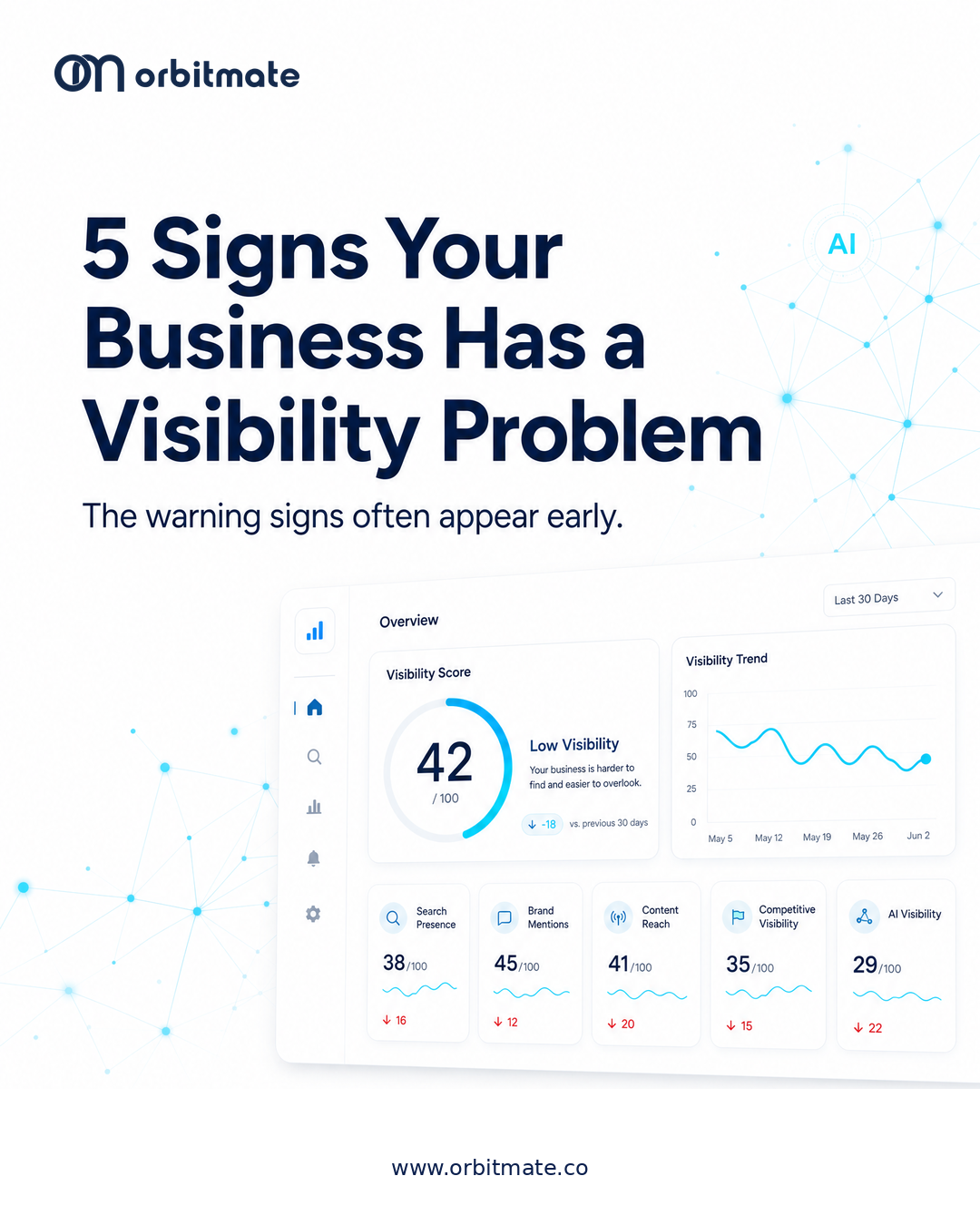
Most visibility problems remain hidden until business growth slows. The warning signs appear long before revenue declines, yet many business owners miss them entirely. By the time leads dry up and sales drop, competitors have already captured your market share.
The good news? Businesses that identify visibility issues early gain a significant competitive advantage. This guide reveals the five critical warning signs and provides a practical audit framework to fix your online visibility problems before they impact your bottom line.
How Do You Know Your Business Has a Visibility Problem?
A business visibility problem exists when your target audience cannot find you through search engines, social media, or industry platforms. Unlike obvious issues like website downtime, visibility problems creep in gradually, making them difficult to detect without proper monitoring.
Key indicators include:
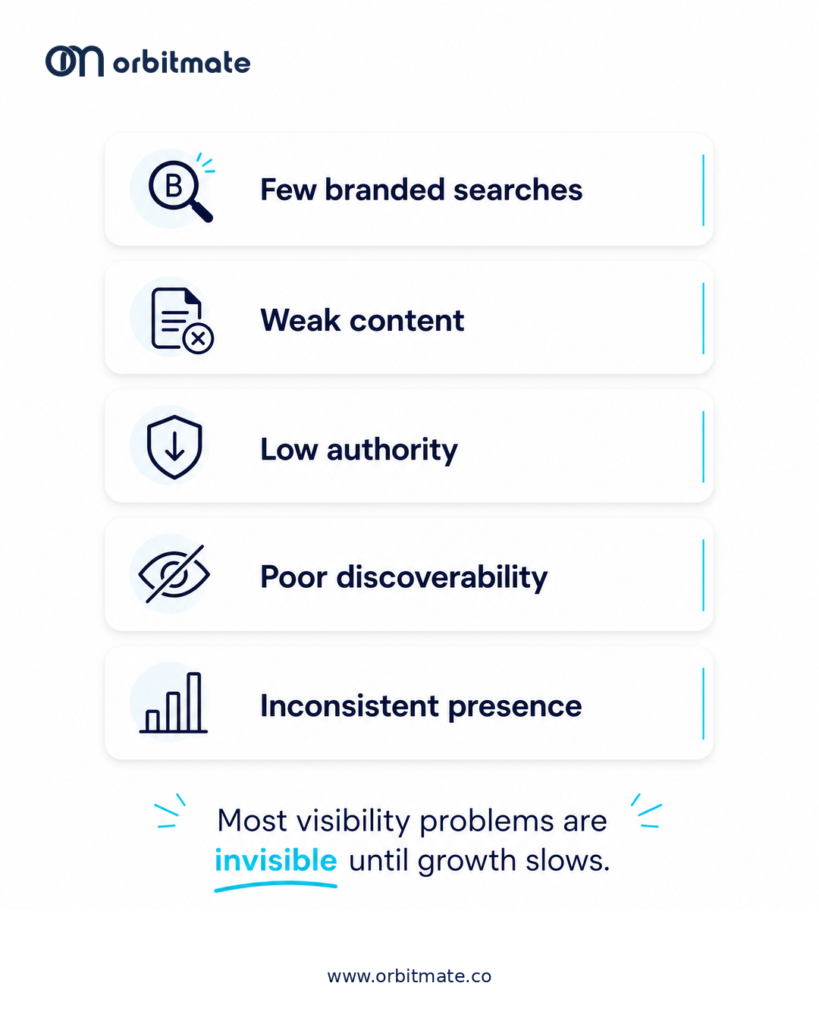
- Declining organic traffic despite consistent content creation
- Few branded search queries in Google Search Console
- Low engagement rates across digital channels
- Competitors ranking for your target keywords
- Minimal brand mentions across the web
Why Isn't Your Brand Being Found Online?
Are You Getting Few Branded Searches?
When customers search for your brand name directly, it signals strong brand awareness and customer loyalty. Few branded searches indicate that your marketing efforts aren't creating lasting impressions.
Why it happens: Insufficient brand building, inconsistent messaging, or limited touchpoints with your audience.
Business impact: Lower customer lifetime value, higher acquisition costs, and reduced referral traffic.
Example: A B2B SaaS company noticed only 50 monthly branded searches despite 10,000 website visitors. This revealed that users found them through generic keywords but didn't remember the brand name—resulting in poor direct traffic and repeat visits.
Solution: Strengthen brand consistency across all channels, implement brand mention tracking, and create memorable brand experiences that encourage direct searches.
Is Your Content Weak or Outdated?
Content quality directly impacts topical authority and search rankings. Thin, outdated, or poorly optimized content fails to satisfy user intent, causing search engines to deprioritize your pages.
Why it happens: Resource constraints, lack of content strategy, or failure to update existing assets.
Business impact: Reduced organic visibility, lower dwell time, and diminished EEAT signals (Experience, Expertise, Authoritativeness, Trustworthiness).
Example: An eCommerce brand selling outdoor gear published product descriptions under 100 words with no unique value. Competitors with detailed buying guides and video reviews dominated search results, capturing 70% of category traffic.
Solution: Conduct content audits, identify gaps using competitor analysis, and create comprehensive resources that answer user questions better than competing pages.
Do You Have Low Domain Authority?
Domain authority reflects your website's credibility based on backlink quality, content depth, and trust signals. Low authority makes ranking for competitive keywords nearly impossible.
Why it happens: Limited link-building efforts, lack of PR, or insufficient high-quality content that earns natural backlinks.
Business impact: Inability to rank for high-value keywords, reduced referral traffic, and lower conversion rates.
Solution: Develop a strategic link-building campaign, create linkable assets like original research or tools, and pursue digital PR opportunities in your industry.
Is Your Technical SEO Blocking Discovery?
Technical SEO issues prevent search engines from crawling, indexing, or understanding your content. Even excellent content won't rank if search bots can't access it.
Common problems:
- Slow page speed
- Mobile responsiveness issues
- Broken internal links
- Improper robots.txt configuration
- Missing schema markup
Business impact: Pages excluded from search results, poor user experience, and lost revenue opportunities.
Solution: Run regular technical audits using tools like Google Search Console, fix crawl errors, optimize Core Web Vitals, and implement structured data for enhanced AI search optimization (AEO/GEO).
Is Your Online Presence Inconsistent?
Inconsistent NAP (Name, Address, Phone) information, conflicting business details, or irregular posting schedules confuse both customers and search algorithms.
Why it matters for local businesses: Google Business Profile accuracy directly impacts local SEO rankings and map pack visibility.
Business impact: Lost local customers, reduced trust signals, and lower local search rankings.
Solution: Claim and optimize all business listings, maintain consistent information across directories, and establish a regular content publishing schedule.
Visibility Warning Signs vs. Business Impact
| Warning Sign | Traffic Impact | Lead Impact | Revenue Impact |
|---|---|---|---|
| Few branded searches | ↓ 30-40% direct traffic | ↓ Brand recall conversions | ↓ Customer LTV |
| Weak content | ↓ 50% organic visibility | ↓ Qualified leads | ↓ Sales opportunities |
| Low authority | ↓ Competitive keyword rankings | ↓ Trust-based conversions | ↓ Premium pricing power |
| Technical issues | ↓ Index coverage 20-60% | ↓ User engagement | ↓ 15-25% revenue loss |
| Inconsistent presence | ↓ Local search visibility | ↓ Local customer acquisition | ↓ Market share |
How Can You Fix Low Online Visibility? A Step-by-Step Audit
Perform this online visibility audit to identify and prioritize fixes:
Step 1: Analyze Search Performance
- Review Google Search Console for branded vs. non-branded queries
- Check impression share and average position trends
- Identify pages with declining traffic
Step 2: Evaluate Content Quality
- Audit top 20 pages for depth, accuracy, and optimization
- Compare against competitor content using gap analysis
- Update or consolidate thin content
Step 3: Assess Authority Signals
- Check domain rating using Ahrefs or Moz
- Analyze backlink profile quality and diversity
- Identify link-building opportunities
Step 4: Test Technical Health
- Run PageSpeed Insights and Core Web Vitals assessment
- Verify mobile-friendliness and indexability
- Check for broken links and redirect chains
Step 5: Review Online Presence
- Audit Google Business Profile completeness
- Verify NAP consistency across 10+ directories
- Assess review quantity and sentiment
Visibility Audit Checklist
| Audit Area | Action Item | Priority | Tool |
|---|---|---|---|
| Brand Visibility | Track branded search volume monthly | High | Google Search Console |
| Content Quality | Update posts older than 12 months | High | Screaming Frog |
| Authority | Acquire 5+ quality backlinks quarterly | Medium | Ahrefs/Semrush |
| Technical SEO | Fix Core Web Vitals issues | High | PageSpeed Insights |
| Local SEO | Optimize Google Business Profile weekly | High | GBP Dashboard |
| AI Optimization | Add schema markup to key pages | Medium | Schema.org |
Frequently Asked Questions
Q1: How long does it take to fix visibility problems? Most businesses see initial improvements within 3-6 months for technical fixes and content updates. Authority building and brand awareness typically require 6-12 months of consistent effort.
Q2: What's the most critical visibility metric to track? Branded search volume is the leading indicator of brand health. However, organic traffic growth, keyword rankings, and conversion rates provide complete visibility performance pictures.
Q3: Can small businesses compete with larger competitors on visibility? Yes. Focus on local SEO, niche keywords, and superior content quality. Small businesses often outperform enterprises in specific verticals through specialization and community engagement.
Q4: How does AI search optimization differ from traditional SEO? AEO (Answer Engine Optimization) and GEO (Generative Engine Optimization) focus on providing clear, structured answers that AI systems can extract. This requires conversational content, FAQ schema, and authoritative data presentation.
Q5: What's the ROI of fixing visibility problems? Businesses that resolve visibility issues typically see 150-300% increases in organic traffic within 12 months, with corresponding revenue growth of 50-150% depending on conversion optimization.
Key Takeaways
✓ Visibility problems precede revenue decline—act before sales drop
✓ Branded searches indicate brand strength—track them monthly
✓ Content quality trumps quantity—focus on comprehensive, authoritative resources
✓ Technical SEO is foundational—fix crawlability before creating content
✓ Consistency builds trust—maintain accurate information everywhere
Conclusion
Your business can't afford to remain invisible. These five warning signs—few branded searches, weak content, low authority, technical barriers, and inconsistent presence—provide early detection of visibility problems that threaten growth.
The businesses thriving today aren't necessarily those with the biggest budgets, but those with the clearest visibility strategies. They understand that discoverability isn't optional; it's essential for survival in digital-first markets.
Don't wait for revenue to decline before taking action.
Ready to uncover your visibility gaps?
Request a comprehensive visibility audit today. Our experts will analyze your search performance, content quality, authority signals, technical health, and online presence—then provide a prioritized action plan to dominate your market.