
The digital landscape is shifting beneath our feet. Artificial intelligence is transforming how people search, find information, and make purchasing decisions. Google's AI Overviews, ChatGPT's search capabilities, Perplexity's conversational answers, and other AI-powered search tools are changing the game.
But with this transformation comes confusion. Misinformation spreads faster than facts. Business owners are making costly decisions based on AI search myths that simply aren't true.
Some say SEO is dead. Others claim AI will replace websites entirely. Many believe only enterprise companies with massive budgets can compete in AI search.
These myths are dangerous. They're causing businesses to abandon proven strategies, waste resources on misguided tactics, and miss enormous opportunities to connect with customers.
Let's set the record straight. In this comprehensive guide, we'll debunk the three most harmful AI search myths and show you exactly what's really happening in the world of AI-powered search. You'll discover actionable strategies to thrive in this new environment, regardless of your business size or budget.
The future of search is here. Don't let myths hold you back.
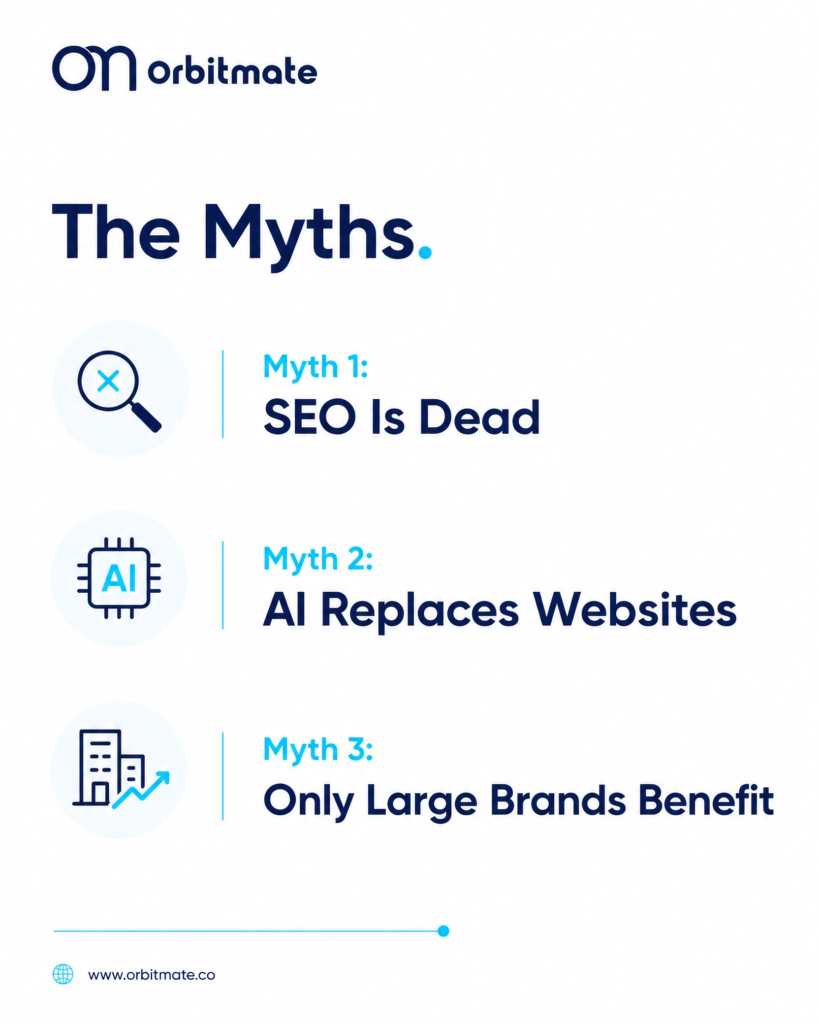
Myth #1: SEO Is Dead Because of AI Search
This is perhaps the most pervasive and damaging myth circulating in business communities right now. Headlines scream "SEO is dead!" Social media influencers claim traditional optimization no longer matters. Some consultants are even advising clients to abandon their SEO efforts entirely and focus solely on AI platforms.
This couldn't be further from the truth.
The Reality: SEO Is Evolving, Not Dying
Search engine optimization isn't disappearing—it's transforming. The fundamentals remain the same: create valuable content, optimize for user intent, build authority, and provide exceptional user experiences. What's changing is how search engines understand and rank that content.
According to recent data from Search Engine Land, websites with strong SEO foundations are actually performing better in AI Overviews and generative search results. Why? Because AI systems need high-quality, well-structured, authoritative content to draw from when generating answers.
Here's what the data shows:
- 75% of AI Overview citations come from pages ranking in the top 10 traditional search results
- Websites with comprehensive schema markup are 3x more likely to be cited in AI-generated answers
- Pages optimized for E-E-A-T (Experience, Expertise, Authority, Trustworthiness) dominate AI search citations
- Long-form, in-depth content (2,000+ words) appears in AI Overviews 40% more often than thin content
Why SEO Matters More Than Ever in AI Search
Think about how AI search works. When someone asks ChatGPT, Google's AI Overviews, or Perplexity a question, these systems don't create information from thin air. They synthesize answers from existing content on the web.
Your content needs to be:
- Findable by search engines
- Well-structured and organized
- Authoritative and trustworthy
- Comprehensive and detailed
- Optimized for semantic search
Without solid SEO, your content won't be discovered, indexed, or considered by AI systems. You're essentially invisible.
The New SEO Landscape: What's Actually Changed
| Traditional SEO | AI-Enhanced SEO |
|---|---|
| Keyword density focus | Topic cluster authority |
| Backlink quantity | Backlink quality and relevance |
| Meta tag optimization | Structured data and schema markup |
| Exact match keywords | Semantic search and NLP optimization |
| Short-form content | Comprehensive, in-depth resources |
| Desktop-first indexing | Mobile-first and voice search optimization |
Actionable Strategies: How to Optimize for AI Search
1. Double Down on E-E-A-T
Google's emphasis on Experience, Expertise, Authority, and Trustworthiness has only intensified with AI search. AI systems prioritize content from recognized experts and authoritative sources.
Demonstrate experience: Include case studies, real-world examples, and first-hand insights Showcase expertise: Highlight author credentials, certifications, and industry recognition Build authority: Earn backlinks from reputable sources, get mentioned in industry publications Establish trust: Provide accurate information, cite sources, maintain transparency
2. Implement Advanced Schema Markup
Structured data helps AI systems understand your content's context, relationships, and meaning. This dramatically increases your chances of being cited in AI-generated answers.
Priority schema types for AI search:
- Article and BlogPosting
- FAQPage
- HowTo
- Product (for eCommerce)
- LocalBusiness
- Organization
- Person (for author profiles)
3. Create Comprehensive Content Clusters
Instead of targeting individual keywords, build topical authority through content clusters. Create pillar pages that comprehensively cover broad topics, then support them with detailed cluster content addressing specific questions and subtopics.
This approach signals to AI systems that you're an authoritative source on the topic, making your content more likely to be cited.
4. Optimize for Conversational Queries
AI search is inherently conversational. People ask complete questions in natural language. Optimize your content to answer these questions directly and comprehensively.
Use tools like AnswerThePublic, AlsoAsked, and Google's People Also Ask to discover the exact questions your audience is asking.
5. Focus on Content Freshness and Updates
AI systems prioritize current, accurate information. Regularly update your content to reflect new developments, statistics, and best practices. Add "last updated" dates and maintain a content refresh schedule.
Expert Insight
"Businesses that treat AI search as the death of SEO are making a catastrophic mistake. What we're seeing is an evolution that rewards the same fundamentals we've always emphasized: quality content, technical excellence, and genuine authority. The companies winning in AI search are those that never stopped doing SEO right." — Industry analysis from Search Engine Journal
Myth #2: AI Will Replace Your Website
Another dangerous misconception gaining traction is the belief that AI search interfaces will make business websites obsolete. The argument goes something like this: "If people get answers directly from ChatGPT or Google's AI Overviews, why would they visit websites? Websites are dead."
This myth is not only false—it's backwards.
The Reality: Your Website Is More Critical Than Ever
AI search doesn't replace websites; it changes how people discover them. Think of AI as the ultimate referral source. When AI systems provide answers, they cite sources. Those citations drive qualified traffic to websites.
Consider these facts:
- AI Overviews include citations linking to source websites in 67% of responses
- Users who click through from AI answers show 40% higher engagement rates
- Website visits from AI search citations have 25% lower bounce rates than traditional organic traffic
- Brands cited in AI answers see significant increases in direct traffic and brand searches
How AI Search Actually Drives Website Traffic
The Citation Effect
When AI systems generate answers, they reference authoritative sources. These citations appear as clickable links, driving highly qualified traffic to your website. Users who arrive via AI citations are already primed with context—they know your site has the information they need.
The Trust Transfer
Being cited by AI systems confers instant credibility. Users think, "If Google's AI or ChatGPT recommends this source, it must be trustworthy." This trust transfer increases conversion rates and reduces sales friction.
The Brand Awareness Multiplier
Even when users don't immediately click through, repeated citations build brand recognition. Your brand becomes associated with expertise in your field, influencing future purchasing decisions.
Why Websites Remain Essential
1. AI Can't Replace Human Connection
AI provides information, but websites facilitate relationships. Your website is where you:
- Build trust through design and user experience
- Showcase your unique value proposition
- Capture leads and nurture prospects
- Complete transactions
- Provide customer support
- Build community
2. You Own Your Website, Not AI Platforms
Your website is digital real estate you control. AI platforms are rented land. Algorithm changes, policy updates, or platform shutdowns can eliminate your presence overnight. Your website is your foundation.
3. Websites Enable Conversion Optimization
AI answers questions, but websites convert visitors into customers. Through strategic design, compelling copy, clear calls-to-action, and optimized user journeys, websites turn interest into revenue.
4. Rich Media and Interactive Experiences
Websites deliver experiences AI can't replicate: video demonstrations, interactive tools, calculators, configurators, virtual tours, and personalized content. These experiences differentiate your brand and drive conversions.
The Symbiotic Relationship: AI Search + Your Website
Think of AI search and your website as partners, not competitors. AI search is the discovery mechanism; your website is the destination where value is delivered and relationships are built.
Optimal Strategy:
- Create AI-citable content that answers questions comprehensively
- Optimize for citations with clear structure, authoritative information, and proper schema
- Design for conversion with compelling landing pages that continue the conversation
- Track AI referral traffic and optimize based on performance data
- Build email lists from AI-driven visitors to create direct relationships
Real-World Example: How One Business Leveraged AI Search
A B2B SaaS company noticed their comprehensive guide appearing frequently in AI Overviews for industry-specific questions. Instead of fearing this would reduce website traffic, they optimized their strategy:
- Added clear CTAs within content
- Created dedicated landing pages for AI-referred visitors
- Implemented exit-intent popups offering valuable resources
- Developed email nurture sequences for AI-driven leads
Result: 150% increase in qualified leads, 40% of which came from AI search citations.
Actionable Takeaway
Don't abandon your website. Enhance it. Make it more valuable, more authoritative, and more optimized for both AI discovery and human conversion. Your website is your most valuable digital asset—treat it that way.
Myth #3: Only Large Brands Can Benefit from AI Search
Perhaps the most discouraging myth is the belief that AI search favors only enterprise companies with massive budgets, established brands, and extensive resources. Small and medium-sized businesses, this myth suggests, don't stand a chance.
Nothing could be further from the truth.
The Reality: AI Search Levels the Playing Field
AI search actually favors smaller, agile businesses that can adapt quickly and provide specialized expertise. Here's why:
1. AI Prioritizes Relevance Over Brand Size
AI systems don't care about your company size or marketing budget. They care about relevance, accuracy, and helpfulness. A small business with deep expertise in a niche topic can outrank Fortune 500 companies if their content better answers the user's query.
2. Long-Tail Opportunities Abound
AI search excels at handling specific, detailed questions. These long-tail queries are where small businesses thrive. While large brands compete for broad, high-volume keywords, you can dominate specific questions your ideal customers are asking.
3. Local Search Advantages
For local businesses, AI search is a game-changer. AI systems heavily weight proximity, relevance, and reviews for local queries. A well-optimized local business can dominate AI answers for "near me" searches and location-specific questions.
4. Niche Authority Is Accessible
You don't need to be an authority on everything. You need to be THE authority on something specific. Small businesses can build deep expertise in narrow niches, making them the obvious choice for AI citations on those topics.
Data That Proves Small Businesses Can Win
- 60% of AI Overview citations go to websites with domain authority under 50
- Local businesses appear in 45% of location-based AI search results
- Niche blogs and specialized publishers earn 35% of AI citations in their categories
- Small business websites with optimized content see 200%+ increases in AI-driven traffic
How Small Businesses Can Dominate AI Search
Strategy 1: Own Your Niche
Don't try to compete on broad topics. Identify specific questions, problems, and needs within your niche. Create the most comprehensive, helpful content on those topics.
Example: Instead of competing for "marketing software," dominate "email marketing automation for real estate agents."
Strategy 2: Leverage Local SEO
If you serve a local market, optimize aggressively for local search:
- Claim and optimize your Google Business Profile
- Build local citations and backlinks
- Encourage and respond to reviews
- Create location-specific content
- Use local schema markup
AI systems heavily favor local businesses for location-based queries.
Strategy 3: Create Specialized Content
Large brands often create generic content to appeal to broad audiences. You can outmaneuver them by creating highly specialized content that speaks directly to your ideal customer's specific needs, challenges, and questions.
Content types that work:
- Detailed how-to guides for specific use cases
- Case studies from your industry
- Comparisons of tools specific to your niche
- Templates and resources tailored to your audience
- Video tutorials addressing specific problems
Strategy 4: Build Strategic Partnerships
You don't need a massive backlink profile. You need the right backlinks. Partner with complementary businesses, industry associations, local organizations, and niche publications. Quality trumps quantity every time.
Strategy 5: Optimize for Voice and Conversational Search
Small businesses can excel at conversational optimization because they're closer to their customers. You know the exact language they use, the questions they ask, and the problems they face.
Incorporate this language naturally into your content. Use FAQ sections. Create content that mirrors natural conversation.
Comparison: Large Brand vs. Small Business AI Search Strategy
| Factor | Large Brand Approach | Small Business Advantage |
|---|---|---|
| Content Scope | Broad, general topics | Deep, specialized expertise |
| Keyword Target | High-volume, competitive | Long-tail, specific intent |
| Geographic Focus | National/Global | Local, community-focused |
| Content Production | High volume, generalized | Lower volume, highly targeted |
| Authority Building | Brand recognition | Niche expertise, relationships |
| Agility | Slow to adapt | Quick to implement changes |
Real Success Stories
Case Study 1: Local Restaurant A family-owned restaurant optimized for "best [cuisine] near me" and specific dish-related queries. They created content about their unique preparation methods, sourced ingredients, and family recipes. Result: Appeared in 80% of local AI search results for their cuisine type, 300% increase in reservations.
Case Study 2: B2B Consulting Firm A 5-person consulting firm created comprehensive guides on specific regulatory compliance issues. While large consulting firms covered general business topics, this firm dominated narrow, high-value queries. Result: 500% increase in qualified leads, all from AI search citations.
Case Study 3: eCommerce Specialty Store A small online store selling specialized outdoor gear created detailed comparison guides, maintenance tutorials, and gear selection tools. They focused on specific activities and conditions. Result: Became the most-cited source in AI answers for their product category, 250% revenue growth.
Actionable Steps for Small Businesses
- Audit your current content for AI optimization opportunities
- Identify 10-20 specific questions your ideal customers ask
- Create comprehensive answers that are better than anything else available
- Implement local SEO if you serve a geographic area
- Build relationships with complementary businesses and local organizations
- Monitor AI search results for your target queries and adjust strategy
- Encourage and showcase reviews to build trust signals
- Stay agile and adapt quickly to new opportunities
Expert Perspective
"The businesses winning in AI search aren't necessarily the biggest—they're the most helpful. AI systems are designed to surface the most relevant, accurate, useful information regardless of source. Small businesses that focus on genuinely helping their audience have a massive advantage." — Digital marketing research from Moz
How to Prepare Your Business for AI Search Success
Now that we've debunked these dangerous myths, let's talk about action. Here's your roadmap to AI search success:
Immediate Actions (This Week)
✓ Audit your website's technical SEO health ✓ Identify your top 20 target questions ✓ Review and update your Google Business Profile ✓ Implement basic schema markup ✓ Create or optimize 3-5 FAQ pages
Short-Term Strategy (This Month)
✓ Develop content clusters around core topics ✓ Build relationships with 5-10 strategic partners ✓ Optimize existing content for conversational queries ✓ Set up tracking for AI search performance ✓ Create citation-worthy resources (guides, tools, data)
Long-Term Vision (This Quarter)
✓ Establish thought leadership in your niche ✓ Build comprehensive topic authority ✓ Develop systematic content refresh process ✓ Create conversion-optimized landing pages for AI traffic ✓ Measure and optimize based on AI search data
AI Search Optimization Checklist
Use this checklist to ensure your business is ready for AI search:
Technical Foundation:
- Mobile-responsive design
- Fast page load speeds (under 3 seconds)
- Secure HTTPS connection
- Clean site architecture
- XML sitemap submitted
- Robots.txt optimized
Content Optimization:
- Comprehensive, in-depth content (2,000+ words for pillar pages)
- Clear heading structure (H1, H2, H3)
- Natural language and conversational tone
- FAQ sections addressing common questions
- Internal linking between related content
- Regular content updates
Authority Signals:
- Author bios with credentials
- Citations and references to authoritative sources
- Original research or data
- Case studies and examples
- Reviews and testimonials
- Industry certifications and awards
Structured Data:
- Schema.org markup implemented
- FAQ schema for question-based content
- LocalBusiness schema (if applicable)
- Product schema (for eCommerce)
- Article/BlogPosting schema
- Organization schema
User Experience:
- Intuitive navigation
- Clear calls-to-action
- Readable fonts and formatting
- Optimized images with ALT text
- Accessible design
- Minimal intrusive popups
Frequently Asked Questions About AI Search Myths
Q1: Will AI search completely replace traditional Google search?
Answer: No, AI search won't replace traditional search—it will complement it. Google reports that AI Overviews appear in only 15-20% of searches currently. Traditional blue-link results remain dominant. The smart strategy is to optimize for both AI-generated answers and traditional search results.
Q2: How long does it take to see results from AI search optimization?
Answer: Most businesses see initial AI search citations within 2-3 months of implementing optimization strategies. Significant traffic increases typically occur within 4-6 months. However, this varies based on competition, content quality, and niche specificity. Consistent effort over 6-12 months yields the best results.
Q3: Do I need to hire an AI search specialist or agency?
Answer: Not necessarily. The fundamentals of AI search optimization align closely with traditional SEO best practices. If you have solid SEO foundations, you're already ahead. Focus on creating helpful, authoritative content and implementing technical best practices. Consider specialist help only if you lack internal expertise or resources.
Q4: Should I stop traditional SEO efforts and focus only on AI search?
Answer: Absolutely not. AI search optimization and traditional SEO are not mutually exclusive—they're complementary. The same high-quality content, technical excellence, and authority-building efforts benefit both. Maintain your traditional SEO strategy while adding AI-specific optimizations like enhanced schema markup and conversational content.
Q5: Can AI search help service-based businesses, or is it only for product companies?
Answer: AI search is excellent for service-based businesses. In fact, service businesses often have an advantage because they can demonstrate expertise through detailed guides, case studies, and educational content. Local service businesses particularly benefit from AI's emphasis on proximity and relevance for location-based queries.
Key Takeaways
Let's recap the essential truths about AI search:
✅ SEO is not dead—it's evolving. The fundamentals matter more than ever. Focus on quality content, technical excellence, and genuine authority.
✅ AI won't replace your website—it will drive qualified traffic to it. Your website remains your most valuable digital asset for building relationships and converting visitors.
✅ Businesses of all sizes can win—AI search favors relevance, expertise, and helpfulness over brand size and budget. Small and medium businesses have significant advantages in niche markets and local search.
✅ Action beats anxiety—Don't let myths paralyze you. Implement the strategies outlined in this guide, measure results, and continuously optimize.
✅ The time to act is now—AI search is rapidly evolving. Early adopters are establishing authority and capturing market share. Don't wait until your competitors dominate AI citations.
Conclusion: Stop Believing Myths, Start Taking Action
The transformation happening in search is real and significant. But fear and misinformation are causing businesses to make costly mistakes. They're abandoning proven strategies, neglecting their websites, and assuming they can't compete.
Don't be one of those businesses.
The truth is empowering: AI search rewards the same qualities that have always mattered in digital marketing—helpful content, genuine expertise, technical excellence, and customer focus. The businesses winning in this new environment aren't necessarily the biggest or wealthiest. They're the most helpful, most authoritative, and most adaptable.
Your path forward is clear:
- Reject the myths that limit your thinking
- Embrace the fundamentals of quality and relevance
- Optimize strategically for both AI and traditional search
- Focus on your niche where you can be the obvious authority
- Take action now while opportunities abound
The future of search is here. AI-powered search isn't coming—it's already transforming how customers find and choose businesses. The question isn't whether to adapt. The question is whether you'll adapt early and thrive, or wait and struggle to catch up.
Your Next Step: Start Optimizing Today
Don't let another day pass while competitors establish dominance in AI search results. Here's what to do right now:
1. Audit Your Current Presence Search for your top 10 target questions in Google, ChatGPT, and Perplexity. Are you appearing? Are you being cited? Document your current position.
2. Pick One Strategy to Implement This Week Don't try to do everything at once. Choose one high-impact action from this guide—whether it's creating an FAQ page, implementing schema markup, or writing a comprehensive guide—and execute it flawlessly.
3. Set Up Tracking Configure analytics to track AI search performance. Monitor citations, referral traffic from AI platforms, and conversions from AI-driven visitors.
4. Commit to Consistency AI search success isn't about one-off tactics. It's about consistently creating helpful content, maintaining technical excellence, and building authority over time.
5. Stay Informed AI search is evolving rapidly. Follow reputable sources like Search Engine Land, Search Engine Journal, and Google's official announcements to stay current.
The businesses that thrive in the AI search era won't be those that panicked and abandoned proven strategies. They'll be the ones that adapted intelligently, doubled down on quality, and served their customers better than ever before.
That business can be yours. Start today.